Case Study

SEVN APP

A curated travel guide for Las Vegas that connects visitors and locals with the city’s best-kept secrets — organized by neighborhood, filtered by category, and recommended by people who actually live there. Curated by locals, for everyone.

Industry Travel / Hospitality
Role Product Designer
Platform iOS / Web
Timeline 6 Months
Company SEVN
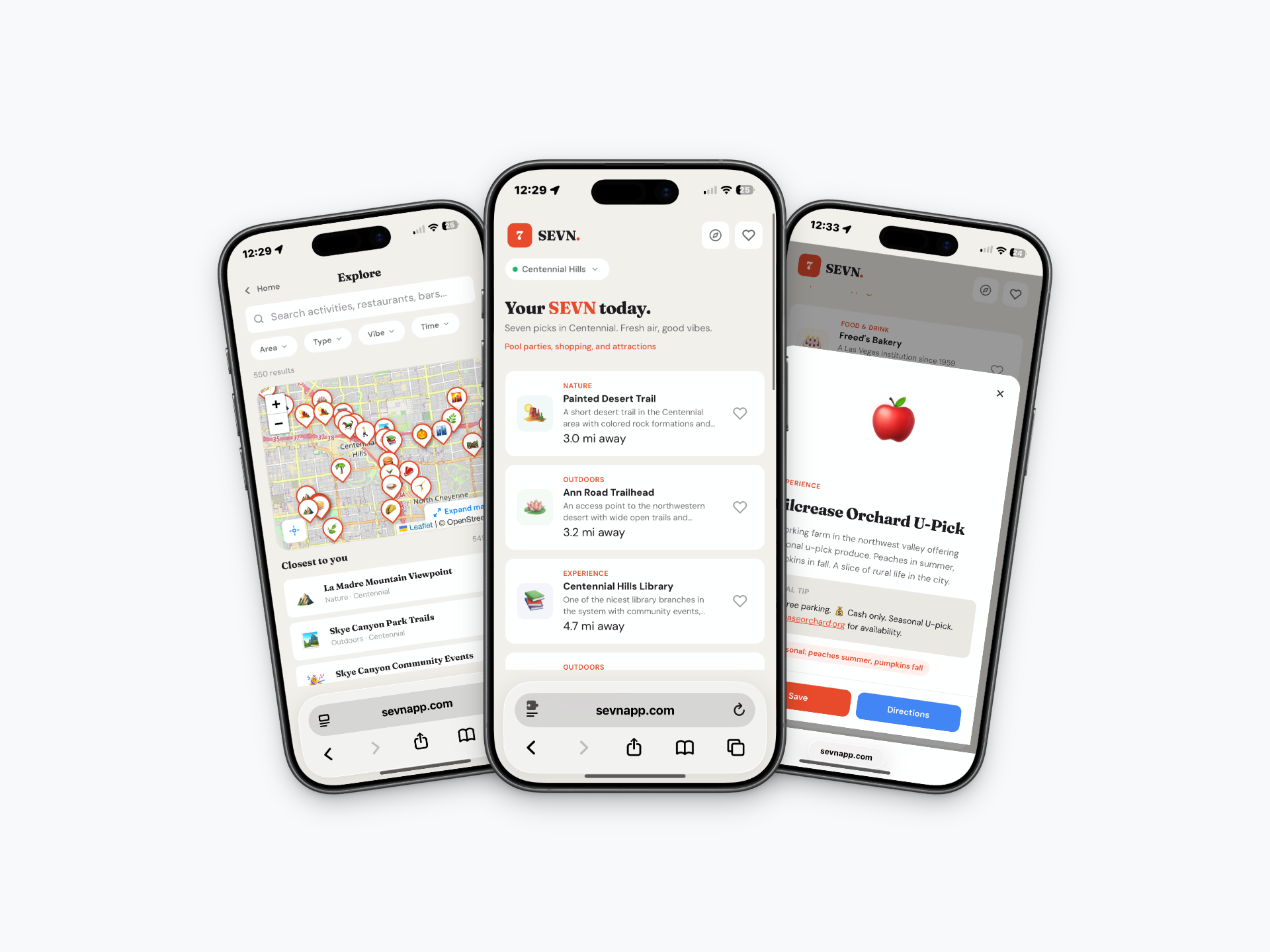
SEVN App Preview
01 — Overview

A Local’s Guide to Vegas,
Built for Everyone

SEVN is a curated travel guide app for Las Vegas that goes beyond the Strip. Instead of generic top-ten lists and algorithm-driven recommendations, SEVN surfaces hand-picked locations from locals who know the city — restaurants, bars, coffee shops, outdoor spots, and hidden gems organized by neighborhood and category.

I joined as the product designer responsible for the end-to-end mobile-first experience — from the discovery flow and neighborhood exploration to personalized recommendations and category filtering. The goal was to make finding great places in Vegas feel effortless, trustworthy, and genuinely local.

View Live Site
Mobile Design Travel Local Discovery iOS
SEVN Logo
SEVN
By the Numbers
500+
Curated locations across Las Vegas — hand-picked by locals, not scraped from directories or generated by algorithms
7 Neighborhoods
Mapped and organized into distinct exploration zones — giving users a sense of place beyond just the Strip
4.8/5
App Store rating from users who found the guide genuinely useful — not just another travel app full of sponsored content
02 — Problem Statement

Generic Recommendations
for a One-of-a-Kind City

Las Vegas attracts over 40 million visitors a year, yet most of them experience the same handful of over-promoted spots. Existing travel apps rely on paid placements and review volume, which means tourists end up at the most marketed restaurants — not the best ones.

Meanwhile, locals who know the city’s real gems had no meaningful platform to share that knowledge. The result was a two-sided problem: visitors overwhelmed by generic, ad-driven recommendations, and a thriving local scene that remained invisible to the people who would love it most.

Every time friends visit, they ask me where to eat. I always send the same list of spots none of them have ever heard of — and they always text back saying it was the best meal of their trip.

— Vegas Local · Early Beta Tester Interview
03 — User Persona

Who We Designed For

Jake Rivera - Tourist
Jake Rivera
Tourist · Marketing Manager
Age
28
Location
Chicago, IL
Tech Proficiency
High
Motivation
Authentic local experiences
Goals
Discover spots that locals actually go to
Explore neighborhoods beyond the Strip
Build a quick, shareable itinerary
Frustrations
Review apps dominated by tourist traps
Too many options with no clear curation
No way to filter by neighborhood or vibe
Behaviors
Asks friends and social media for recs
Prefers quality over quantity in results
Plans loosely — wants options, not schedules
💡
How Jake shaped the design
Jake doesn’t want to scroll through 200 results — he wants five great ones. That insight drove two core decisions. First, recommendations had to be tightly curated, not algorithmically exhaustive. Second, neighborhood-based browsing had to feel like exploring a real map, not reading a spreadsheet. If a 28-year-old who researches everything on his phone can’t find a great dinner spot in under 30 seconds, the app has failed.
04 — Research & Insights

What Visitors and Locals Told Us

I conducted interviews with both tourists and Las Vegas residents, ran a competitive analysis of existing travel and discovery apps, and analyzed behavioral patterns from early beta testers. The findings were consistent: people wanted fewer, better recommendations from sources they could trust.

🌏
Neighborhood Context Matters Most
Users consistently said they wanted to understand where a place was in relation to where they were staying. Neighborhood grouping — not just category filtering — was the missing layer in every competing app we analyzed.
Curation Beats Volume Every Time
In user tests, people felt more confident choosing from a list of 8 curated spots than from 80 algorithm-ranked results. Trust came from knowing a real person selected the recommendation — not from star counts or review volume.
📱
Discovery Happens on the Go
Over 85% of beta users accessed the app on mobile while already in Las Vegas. The experience had to be designed for one-handed use, quick scanning, and fast decision-making — not lean-back browsing at home.
05 — Design Process

From Insight to Interface

01
Discovery
User Interviews, Competitive Audit & Beta Analytics
Interviewed 20+ tourists and locals to understand how people currently discover places in Las Vegas. Audited Yelp, Google Maps, TripAdvisor, and niche travel apps to identify gaps. Analyzed early beta usage data to see where users dropped off and what they engaged with most.
02
Define
Information Architecture & Content Strategy
Mapped the full taxonomy of locations across neighborhoods and categories. Defined the content hierarchy — what information users need at a glance versus on tap. Created user flows for the three core journeys: browse by neighborhood, filter by category, and get personalized suggestions.
03
Design
Mobile-First UI & Neighborhood Exploration
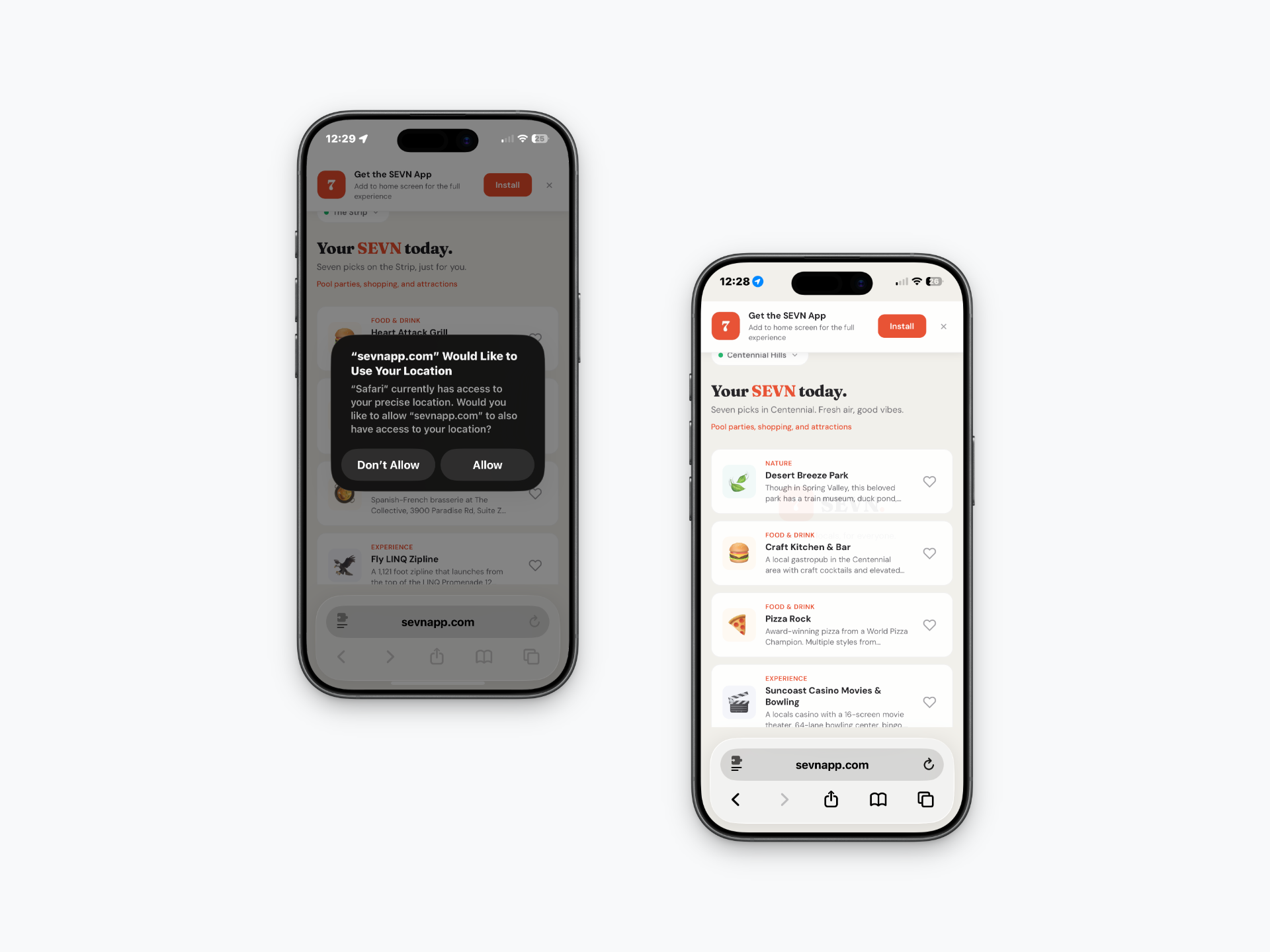
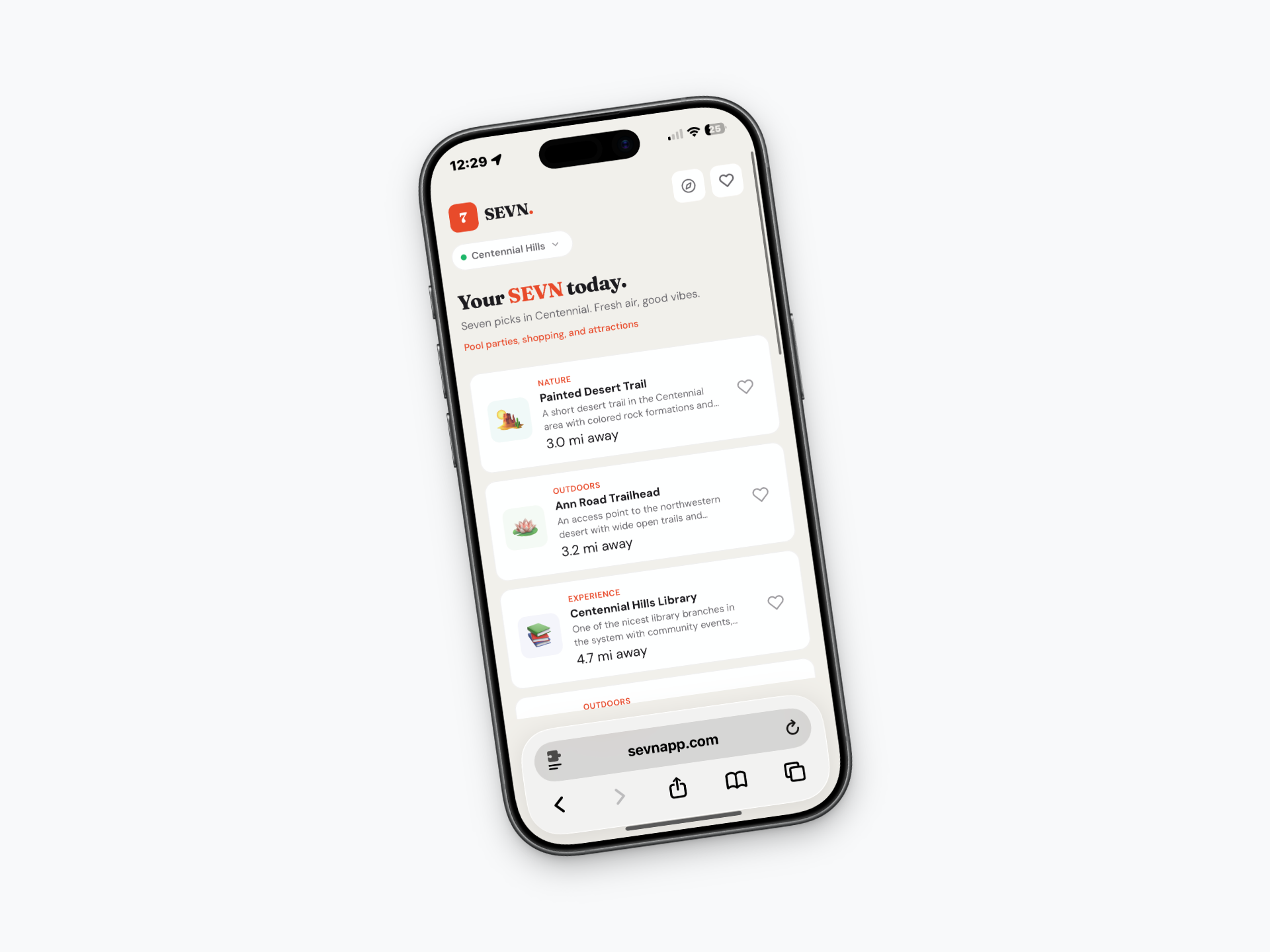
Designed a card-based interface optimized for one-handed mobile use. Built the neighborhood exploration flow as an immersive, map-driven experience. Created the category filtering system with visual indicators and quick-toggle controls. Established a warm, vibrant visual language using SEVN’s orange, cream, and green palette.
04
Validate
Usability Testing & Iterative Refinement
Ran usability tests with both first-time visitors and returning locals. Tested the discovery flow in real-world conditions — on the Strip, in an Uber, at a hotel. Iterated on card density, filter placement, and neighborhood map interactions based on direct observation and session recordings.
06 — Design Solution

A City Guide That Feels
Like a Friend’s Recommendation

The final design delivers a focused, trustworthy discovery experience that makes finding great places in Las Vegas feel personal — not transactional. Every interaction was designed for speed, clarity, and confidence.

🗺
Neighborhood-First Exploration
Users browse Las Vegas through an interactive neighborhood map that gives spatial context to every recommendation. Tapping a neighborhood reveals its curated spots, local vibe description, and distance from the user’s current location.
🏷
Smart Category Filtering
A persistent filter bar lets users toggle between categories — food, drinks, coffee, outdoors, nightlife, and more — without losing their place. Filters combine with neighborhood selection for precise, relevant results in seconds.
Personalized Suggestions
Based on saved spots and browsing patterns, SEVN surfaces personalized recommendations that evolve with the user. The suggestion engine prioritizes variety and proximity, helping users discover new neighborhoods they wouldn’t have explored otherwise.
SEVN App Interface
07 — Outcomes

Turning Local Knowledge
Into a Product People Trust

Users Found Places in Under 30 Seconds
The neighborhood-first flow and category filtering reduced time-to-decision dramatically. In usability tests, users went from opening the app to choosing a spot in under 30 seconds — compared to minutes of scrolling on competing platforms.
Neighborhood Exploration Drove Deeper Engagement
Users who started with the neighborhood map viewed 3x more locations per session than those who searched directly. The spatial browsing model encouraged exploration and discovery beyond the user’s initial intent.
High Trust Signals From Day One
The curated approach paid off immediately. App Store reviews consistently mentioned trust and authenticity — users felt confident acting on recommendations because they knew a real local had selected each spot, not an algorithm.
Local Contributors Became Advocates
Las Vegas residents who contributed recommendations became the app’s most passionate advocates. The design gave them a platform to share their city with pride — turning local knowledge into a scalable, community-driven product.
08 — Key Learnings

What This Project Taught Me

Learning 01
Less Content, More Confidence
Showing fewer, better options consistently outperformed showing more. In travel discovery, curation is the product. The design lesson was to resist the urge to surface everything and instead earn trust by being selective — every spot in SEVN is there for a reason.
Learning 02
Context Is the Killer Feature
Neighborhood context transformed how users related to recommendations. A taco shop means something different in Downtown versus Chinatown. Designing around spatial relationships — not just lists and ratings — made the experience feel genuinely useful and differentiated.
Learning 03
Design for the Moment of Use
Most users were on their feet, in transit, or making plans at a hotel. Designing for that context — one hand, bright sunlight, limited attention — forced better hierarchy, larger touch targets, and faster load times. The constraint made the design stronger.
Next Case Study
Peelr